
Section 4: One Stage Basilic Vein Transposition Video Presentation
Summary text for the basilic vein transposition procedures.
The basilic vein lies in a deep sub-fascial position in the arm and in close proximity to the to the brachial artery a procedure to move it to a more suitable position is required. There are three distinct procedures described for this:
- The one stage Basilic Vein Transposition (BVT) procedure (shown below in 19 video clips). This is the preferrred procedure by the authors and described in detail below.
- The two stage BVT procedure. First the basilic vein – brachial artery anastomosis is made followed by a second procedure where the basilic vein is transposed similar to the on-stage above. This second procedure may take place weeks later. We are not recommending this approach as it adds stress to the co-morbid ESRD patient and extends time on central vein catheter dialysis.
- Superficialization Techniques are also not recommended as the vein is placed in an open space with risk for fluid collection and hematomas. The cephalic vein will be too medial on the upper arm which is awkward for the patient during dialysis sessions.
Key Surgery Points of the one stage Basilic Vein Transposition Procedure
The following summary text is also reflected in the linked video-clips below for the one stage transposition procedure. Patients for BVT should be selected using duplex ultrasound examination. As a guide the standard size parameter for AVF screening is used. The following link describes the use of Ultrasound in Dialysis Access. (Document 2 Ultrasound Applications)
Ideally an immediate pre-operative Ultrasound Scanning (USS) to mark the vessel position is performed. If not, a detailed note is made to guide surgery later. Rather than viewing the brachio-basilic vein upper arm transposition vs. PTFE graft as completive procedures, a better approach is to carefully consider the pros and cons for each and select the procedure accordingly patient specifics at the time. To blindly explore, looking for a vein and determining its adequacy at time of surgery is not acceptable surgical practice. As the basilic vein commonly enters one of the brachial veins at mid upper arm level the procedure may be a combined basilic and brachial vein transposition procedure. The ultrasound examination also will document the presence of two arteries due to high bifurcation of the brachial artery /dominant profunda brachii as seen in 15-20 % of cases. The larger (ulnar) artery which lies deeper is used for anastomosis in such cases. A detailed surgical description of the one step BVT procedure can be viewed in the attached PDF link and a step-by-step walk through is shown in the 19 video clips linked below.
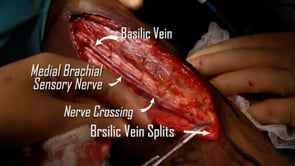
Regional nerve block, such as the supraclavicular block, is beneficial as the vascular structures will dilate. Optimal positioning of the patient’s arm on an arm board is important for the surgeon’s comfort and patient safety. As the dissection proceeds, side branches become exposed. The author’s double clip branches towards the arm and suture ligate toward the basilic vein. There are uniformly large branches connecting the basilic vein to the deeper brachial veins at various levels. The basilic vein usually divides about 4-6 cm above the antecubital fossa. There is wide and often complex variation in venous anatomy of the basilic and brachial veins. The author tends not to divide and ligate larger branches until certainty has been established as to what vessel and how long transposition segment is needed. Often the bifurcation of the median antecubital vein (an extension of the basilic vein) as it gives off the vena communicates to the deep concomitant brachial vein 1-3 cm below the antecubital skin crease, can be incorporated to gain vein length.
Medial antebrachial cutaneous nerve anatomy is quite variable, and a word of caution is warranted. The most common surgical injury during the BVT procedure is to the medial antebrachial cutaneous (sensory) nerve. It is commonly adhered to the basilic vein on the lateral (radial) aspect. Distally above the elbow the nerve usually splits and crosses over the basilic vein. The entire length of the basilic vein is exposed during BVT and the medial antebrachial cutaneous (sensory) nerve must be left intact and completely separated from the vein. An atraumatic vascular clamp is placed proximally on the vein facilitating dilating the vein under slight pressure by injecting heparinized (10 units/ml) saline. This also reveals leaks from missed venous branches, which will cause severe tunnel bleeding and hematomas which may cause the BVT procedure to immediate fail. The brachial artery is mobilized at the antecubital fossa and surrounded by vessel loops. The antecubital vein bifurcation is ideally used as a patch end-basilic vein to side brachial artery anastomosis, like that described above for the wrist radio cephalic AVF technique.
Different tunneling techniques can be used but we recommend a sheath/tube tunneler. The corner stitches are attached to the rod inside the sheath tunneler. The rod is then pulled feeding the vein into the sheath. As the entire vein is pulled inside, the sheath is also pulled out the tunnel tract exposing the end of the vein at the distal aspect of the wound still sutured to the rod. The sutures are cut to free the vein from the rod. Orientation is maintained by immediately placing the final corner stitches such as Prolene 6-0 or 7-0 or PTFE CV6 or a TTc12. The vein is again distended with saline to ensure lack of kinking or other mechanical mishaps during tunneling. The vein should be visible and palpable as a continuous subcutaneous conduit.
The superficialization procedure alone involves mobilizing the entire vein as described above and in the video clips. The difference between superficialization and transposition is that the vein is not tunneled (or transposed) into a tract (tunnel) but moved more superficially and placed under the skin to facilitate cannulation. If a new anastomosis is not desired, it is recommended to place the vein in a surgically created skin flap. There are two disadvantages with the superficialization only procedure. First, the vein will be placed in a large “dead space” vacuum with potential for hematoma and seroma formation. Second, the fistula vein will end up more medial than optimal, making the cannulations more difficult and uncomfortable for the patient during the dialysis sessions. We do not recommend the superficialization procedure be used at any time.
The following 19 Video clips demonstrate the important steps of one stage BVT below. Each video title is followed by a brief description of the highlights of each segment.
These video segments illustrate crucial aspects of the BVT procedure. There are many variations that develop with experience and some of these are addressed in each video clip as appropriate.
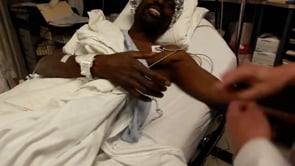


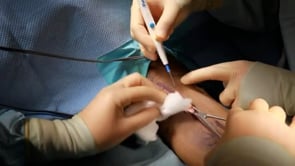
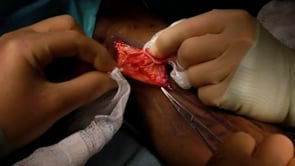

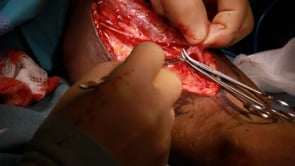
Basilic Vein Transposition (BVT) using skin bridges. This slightly different approach preferred by some like the above is highlighted in the steps below: The improved cosmetic benefits are minimal (Figure 35) and may not justify the increased surgical difficulties. The planning and procedure steps are similar as outlined:
- Pre-operative ultrasound to mark veins and map side branches.
- The planned incisions (2-3 cm long) with skin bridges are marked.
- Mobilization of veins above BUT through limited incisions (a lighted retractor can help although not essential)
- All side branches are tied and divided, and the nerve is preserved.
- The basilic vein is marked with a pen
- The vein is divided at a level near the elbow
- A tunnel is created – a hollow tunneler or a cut 8 mm endo-trachea tube
- The vein is tunneled atraumatic to the elbow.
- Once position is ensured an end-to-end anastomosis is performed with the transposed vein
- The skin is closed over the dissection sites.
This approach preserves the cylindrical arm anatomy and prevents anatomical distortions such as ‘dogears” with a longer incision (Figure 36).